
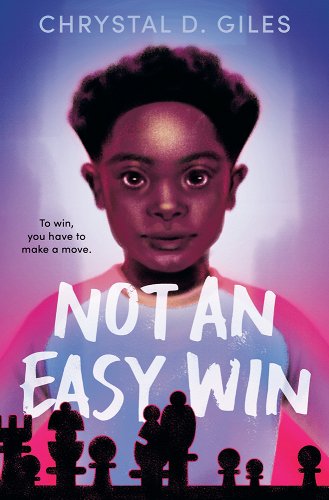
by Chrystal D. Giles. Random House, 2023.
Review of published copy.
Tags: Poverty; Incarceration; Intergenerational and Familial Relationships; Racism.
Chrystal D. Giles made her debut as a writer with the critically acclaimed Take Back the Block published in 2021. Not an Easy Win, which prominently features competitive chess, is her second middle-grade novel. In an interview with Publisher’s Weekly (by Erika Hardison, February 28, 2023) she spoke of the impetus for the story: “The idea came some years ago as I was watching a documentary on a chess grandmaster. He talked a lot about how chess changed his life and how he thought the lessons in patience you learned from playing the game can be applied to life. I took that in the back of my head and I thought I could tell an interesting story.”
Prior to her writing career, she spent fifteen years as an accountant. She currently lives outside of Charlotte, North Carolina.
Faced with some challenging experiences and poor decisions, a boy finds his space and place through the game of chess.
Life is not going well for twelve-year-old Lawrence who has had to move from Charlotte with his mother and sister to live with his religiously devout and stern Granny in rural North Carolina after his father is incarcerated. There he attends a predominately white school, where after too many fights, he is expelled for defending himself against bullies (“It wasn’t my fault… No one cared that I had a huge target on me since the day I started at that school. Everyone just looked at me like I was the problem.”, p. 4). Hearing Granny’s reaction, “Well a man that don’t work don’t eat” (p.12), he realizes he has to figure out what to do next since Granny makes it clear that “he can’t stay here all day watching TV” (p. 18). A neighbor, Mr. Dennis, who co-owns the Carver Recreation Center where he directs a before- and after-school program, offers a solution to his dilemma by giving him a volunteer job. His plight begins to change for the better when, at the center, he thrives in the space with new African American peers including Twyla, “the queen of chess” and a crush interest, and Deuce, a menacing nemesis. Under the mentorship of Mr. Dennis, who reminds him, “Chess is a game for thinkers.” (p. 63), Lawrence learns to play chess and recognize how beneficial lessons learned from the game are helping him shape a brighter outlook on life.
In this distinctively crafted story of tween angst, Giles has created an authentic protagonist in Lawrence who, struggling with dejection and internal conflicts, learns new coping skills with the help of a loving family and a new community of friends. Issues of poverty, incarceration, racism, and intergenerational relationships are seamlessly infused into a plot that is both cleverly constructed and immensely satisfying.
What works:
Use of the game of chess as a metaphor for making the right moves as in the game and making the right decisions as in life.
Insightful presentation of tween angst as reflected in Lawrence’s adjustment to a new school and confronting family problems out of his control.
Intergenerational familial relationships portrayed in the conventional no-nonsense grandmother characterization.
Realistic pattern of growth in the protagonist, Lawrence.
After sharing some good news with Granny, she said, “You’ve really turn things around.” and Lawrence responded,
I really had.
I’d made it through a lot. Pop leaving. Moving three times. Being expelled. Pop gone. Ma hardly being around. But, I’d had some good come my way. Mr. Dennis had given me a job at the rec. I had more friends than I’d imagined I’d have here. Chess had gotten me to stop and think about my next move before doing something silly.” (pp. 234-235).
As he reflected on his new outlook, Lawrence observed,
There was more to me than people saw. I’d figured that out too. I was more than the kid who moved around a lot. I was more than the troublemaker who got into fights. I was more than my pop being gone. I didn’t want to be trapped by that history. (p. 238)
What doesn’t work:
This novel was completely satisfying.
Pass It OR Grab It?
Grab It. A winning read with all the right moves for any middle schooler.
 Black Cotton Reviewers