
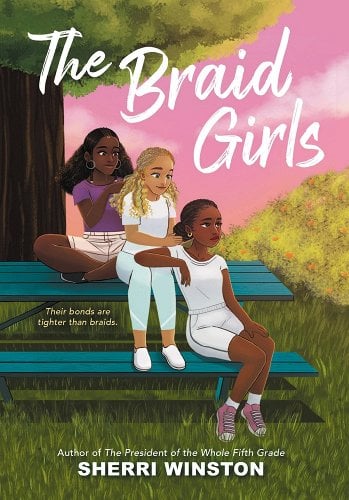
by Sherri Winston. Little, Brown and Company, 2023
Review of published copy
Tags: Friendships, Family Relationships, Youth Entrepreneurship, Loss of Parent, African American Hair Braiding.
Sherri Winston grew up in Michigan. She attended Michigan State University and lived all over the country as a journalist before settling in South Florida where she worked as a nespaper columnist, and became a mom. Writing books and illustrating were a lifelong ambition for Winston. Now, she splits time between Orlando, FL and Charlotte, NC with her adult daughter, two cats and a geriatric dog who occasionally wets the floor. In 2022, she was long listed for the National Book Award for Lotus Bloom and the Afro Revolution.
Inspired by memories of her youth, she describes The Braid Girls as “a homage to those long-gone days.”
Back in the day, if you didn’t know how to braid, the neighborhood girls who did were Queens!
When you’re in sixth grade, it’s hard convincing parents to pay $100, $200 even $300 for a new ‘do. Professional braids could cost a small fortune. However, paying $50 to a classmate with magic fingers? That was doable.
I spent many a afternoon sitting out in front of my friend Pam’s house as her younger brothers went skrt-skrt in between the feet and bodies of the tittering girls congregated on their front stoop.
Those were good times.
(https://voteforcupcakes.com/about/)
Three middle school girls come of age in an enjoyable story about navigating peer and familial relationships.
Two best friends, Maggie and Daija, begin a hair braiding business to earn money during the summer. Maggie’s half-sister, Callie, comes to live with the family and joins the girls in the business. Working at a camp as junior counselors gives them an opportunity to offer their services to the campers. The business thrives until a competing group of girls at the camp offers the same services for lower prices and begin to lure their customers. Their disagreement on how to handle the situation and some unresolved personal issues create tension that threatens the friendship. Through honest talk, they realize the strength of their bond. Dajia, “…we all agreed to be better at speaking up and about what we need and want. / And we agree to do a better job in checking our egos and our emotion.” (p. 220). Maggie, “Since our talk, I’m feeling like the girls and I understand one another better. We had been holding on to our feelings and not really letting one another in. Clearing the air, lifted a ton of weight off all our shoulders.” (p. 227).
Winston’s relatable characters and their dilemmas define the varied themes of the novel.
Daija, who lives with her mother, aspires to become a professional ballet dancer but needs money to pay for lessons; the braiding idea is her means to make money. Her father has remarried and moved his new family from Miami to Jacksonville to be close to her although he is distant and spends little time with her. She longs for attention from him and his approval of her career choice. Her most pressing issue is her relationship with Maggie, her best friend, who she feels could replace her with Callie. “Maggie is not only shy but also naïve. It’s up to me to make sure she doesn’t get walked on by this girl. And I have to make sure Callie isn’t going to try pushing her way between me and Maggie. (p. 50).
Maggie lives with her parents and a young sibling. She is reticent about speaking up for herself as described by a nemesis (from the competing hair braiders), “I can’t believe you even have the nerve to try to start a business” …” Everybody knows you can’t do nothing for yourself. That’s why Dajia is always fighting your battle. You ain’t got no backbone and you don’t know how to stand up for yourself! Just a crybaby.” (p. 117). But she is clear about her ambitions, “…I’m trying to earn me enough money so I can save and start other businesses. One day, I want to buy property and charge people rent. That’s called ‘passive income.’ (p. 80).
Callie joins the family following the death of her mother who had kept the secret of Callie’s birth from her father. “I’ve been dreaming about meeting my father forever. I used to beg Mom to tell me who he was, but she wouldn’t. Not until a year ago, when she got sick.” (p. 31). As she tries to fit in while still mourning the loss of her mother, she is consumed by guilt, “Then I get to the things that have been bothering me since I came…How every time I feel myself getting settled with the family, I feel disloyal to Mom somehow.” (pp. 234-235).
What works
Effective portrayal of middle school tweens through the use of alternating voices.
Evenly interwoven topic of hair braiding revealing interesting facts about styles / techniques.
Well-paced plot.
What doesn’t work
Unresolved conflict with the “mean girls” (the competing business).
Pass It OR Grab It?
Grab it for a public or school library collection. Readers will find its positive and upbeat tone appealing and satisfying.
 Black Cotton Reviewers