
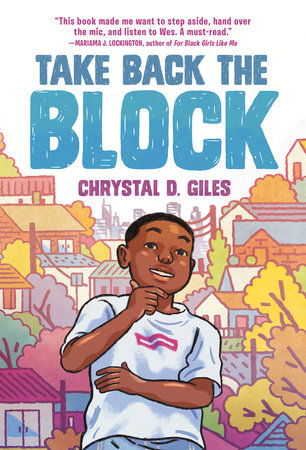
By Chrystal D. Giles, Random House Books for Young Readers, 2021
Author Chrystal D. Giles, a 2018 We Need Diverse Book mentee, brings a fresh and absorbing perspective to her debut novel, Take Back the Block, available as an e-book and in audio format. Giles’ work has been recognized with numerous awards, including the ILA Social Justice Literature Award. Her subsequent novel, Not an Easy Win, continues this trend with another infectious lead character navigating Black boyhood with creativity, self-awareness, and optimism.
Through Wes, the narrator in Take Back the Block, Giles offers an invitation to understand issues like gentrification, displacement, communal advocacy and support, and familial resilience. Wes is a conscientious eleven-year-old who loves video games, stylish clothes, and hanging out with his core friends. Wes is an only child living in a working-class community (The Oaks) with two loving parents who are anchors and activists against over-development and replacement in their community. There are multiple sub-plots related to middle school angst and the accompanying social anxieties, tensions, and hierarchies within Wes’ friendship circle, including Wes’ emerging sense of self and obligation to his personal values and working-class community. Wes’ mother takes him to a local protest where tenants who live in old apartment buildings are being pushed out. Wes feels detached, but soon enough, racial and economic stratification inches closer for Wes on multiple levels as one of Wes’ close friends, Mya, moves from the Oaks to the “rich side of town where all the houses are brick and have at least three-car garages.” Another friend from the Oaks is experiencing housing insecurity. The central tension and plot centers around community members being offered money for their modest working-class homes to raze The Oaks to make way for wealthier residential and commercial properties. The value of community beyond money, such as the people, relationships, shared history, and housing affordability, are significant looming questions that Giles addresses in addition to kids at the middle school level considering the scale of things to concern themselves with as they learn about societal injustices.
Grab it : Giles effectively transports readers into Wes’ neighborhood, school, and tight social circle through well-crafted dialogue using humor and levity throughout in ways that echo the sonic resonance of middle schoolers. Giles’ development of characters and dialogue would make for an excellent mentor text and craft lesson in ELA classrooms.
Chrystal Giles provided an affirming window into working-class family life, neighborhood context, and communal care. Challenges associated with how youth negotiate class, race, and gender dynamics are not heavy-handed, which leaves space for conversations about how youth negotiate social pressures and realities individually and collectively. The discussions about gentrification and housing insecurity provide multiple levels for understanding current and historical challenges related to affordable housing, racial segregation, communal resistance, and activism.
Take Back the Block is versatile, perfect for independent reading, whole-class discussions, or book club selections. Its engaging narrative and thought-provoking themes make it a compelling choice for any reading setting.
 Black Cotton Reviewers