
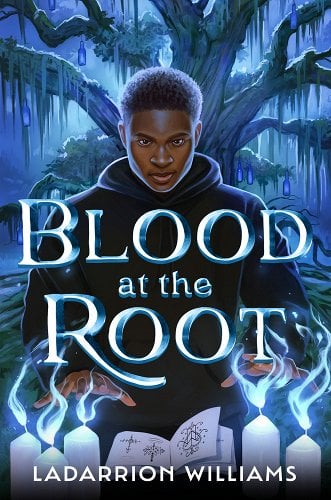
By LaDarrion Williams. Labyrinth Road, 2024
LaDarrion Williams hails from Helena, Alabama, and is a self-taught playwright, filmmaker, screenwriter, and author. Blood at the Root is his debut young adult novel, which ushers in a new story of Black boy magic, bringing in stories from across the diaspora.
Ten years ago, Malik’s mother went missing, and he’s not sure if it was the mysterious strangers he found in his home or his magic manifesting the same day. Now, he’s recently emancipated himself to get out of the foster care system, and he’s on a mission to kidnap his (foster) brother to get him out of an abusive home. But the kidnapping turns into Malik reuniting with the grandmother he didn’t know he had and enrolling in a magical HBCU, Caiman University, where his mother attended. While at Caiman, Malik is surrounded by other magical Black folks from across the diaspora, and he’s set on finding out what happened to his mother. As he learns more about the magical world that’s been hidden from him his whole life, Malik unearths secrets that will change the trajectory of his life and his community, and it’s not quite clear if it will be for the better.
What Works: The story very much captures moments that feel realistic of interactions between teenagers. There’s lots of AAVE used within the story, references to Black American cultural touchstones, and plenty of cussing when adults aren’t around – and exasperation from adults when they are present for it. This works very effectively in the audiobook, but the dialectic choices might bog the story down in a physical format where it might be difficult to hear the intonation choices. Malik is seventeen (apart from flashbacks), and the college campus setting makes certain aspects of the story more believable for situations that just wouldn’t work as effectively if parents were around. The story also includes mention of Black historical figures, which might inspire readers to learn more about them. Moments of Black boy joy and Malik’s relationship with his younger foster brother offer bright spots to an otherwise emotionally heavy story dealing with everything from the foster care system, child abuse, missing and murdered Black children, and generational trauma.
What Doesn’t Work: The pacing at certain points in the story felt a bit off in that there would be moments where the action is moving quite quickly, and suddenly, a heap of time would have passed. These transitions could have been smoother. There isn’t a whole lot underpinning the magical system. With Malik being new to an already concretized world, readers might expect more information about the magic. There are also moments within the story that could easily be seen as homophobic or misogynistic. We see that Malik hasn’t spent a lot of time around queer folks and his beliefs around queerness are homophobic, but he does come to a more accepting mindset through his new roommate and friends – although this might feel like it’s part of the story for Malik’s character development and as a checked box in terms of including diverse identities. Additionally, Malik often thinks about and sees the women he interacts with – particularly other students – in terms of their looks. A generous view of this is that Malik has grown up without a stable homelife, and so might treat women poorly based on how society treats them in popular media. This is something that could be rectified or serve as a teaching moment in subsequent books. A less generous reading would be that this book contributes to the oversexualization of Black girls that sees them as only valuable in terms of what they can offer to men.
Pass It or Grab It: Grab it! But with a grain of salt. Blood at the Root deals with some heavy topics that may not be amenable to all readers. While we have lots of fun magical elements, the depictions of girls and queer folks might require some conversation, especially if there’s no growth in these areas in sequels.
Content Warnings: violence, blood, death, slavery, misogyny, homophobia,
 Black Cotton Reviewers