
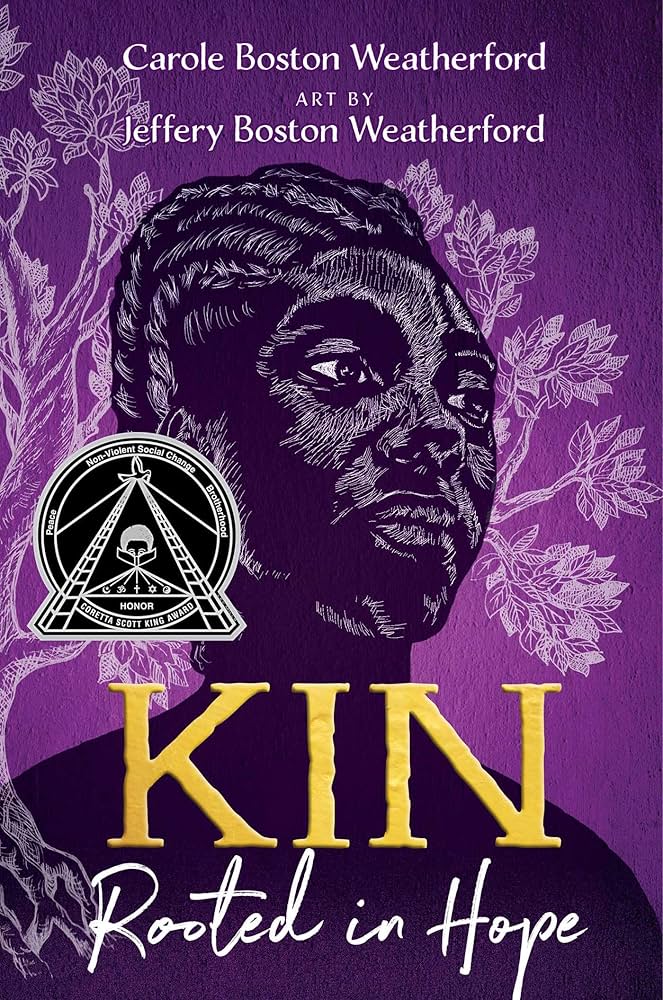
by Carole Boston Weatherford, art by Jeffery Boston Weatherford, Atheneum Books for Young Readers, 2023
In her author notes at the end of the book, Ms. Weatherford writes that “growing up, I knew of only one formerly enslaved ancestor—Phillip Moaney, a co-founder of the all-Black village of Copperville.” Further down in her notes Weatherford adds, “I was grown by the time I learned of another great-great grandfather, Isaac Copper. He fought in the U.S. Colored Troops and co- founded the nearby all-Black village of Unionville.” Given that information, she waned to learn more about her family history. She knew that researching her genealogy would be a daunting task and she set aside that project. However, her curiosity was sparked in Frederick Douglass’s autobiography which was set partially at Wye House—Maryland’s largest slaveholding plantation. In his autobiography, “Douglass added that Isaac, a healer and minister, was often
given the honorific title of Doctor. . .he considered him a good man.” She wondered could that Isaac Copper be her great-great-grandfather? Thus, her research began leading her to many places and to many documents; with gaps in between. She gathered as much information as she could. However, her genealogical research of her family tree “went dark after five generations.”
Kin is the product of Ms. Weatherford’s extensive research. Through Weatherford’s poetry, her ancestors told their stories: Isaac and Nan Copper, both house servants, talked about their duties under the watchful eyes of the Master and Mistress Lloyd. The Copper children, Prissy, Marena, and Henry talked about their work under the masters. Other enslaved families shared their stories: Chicken Sue, Katy, Daphne and field hands talking about their lives and work. Weatherford included the stories from the Lloyds’ and their son, Daniel. She added Frederick Douglass’s and Harriet Tubman’s story for more history and context. Even Chessie, the Chesapeake Bay Retriever, tells its story and enlightens the reader on its breed. Kin is more than a story of family and history. Kin embodies Ms. Weatherford’s idea “that knowledge of one’s heritage is a form of generational wealth and that our stories are our treasures.”
What works: Weatherford’s poetry to tell family stories and histories is powerful, authentic, and informative. Her son, Jeffery, effectively illustrates and captures the essence and spirit of each person, including the dog. Weatherford’s decision to include the Lloyd’s and other people’s stories add additional information and perspective about life in the community.
What doesn’t work: I, personally, would love to read more stories from the Copper family. However, Weatherford’s research hit a wall. She did her best with what she had.
Pass it or grab it: Grab it! This book can be used to share Weatherford’s genealogy, and could also be used as a jumpstart/catalyst for students to write their own genealogy story. This book is appropriate for middle grades and up.
 Black Cotton Reviewers