
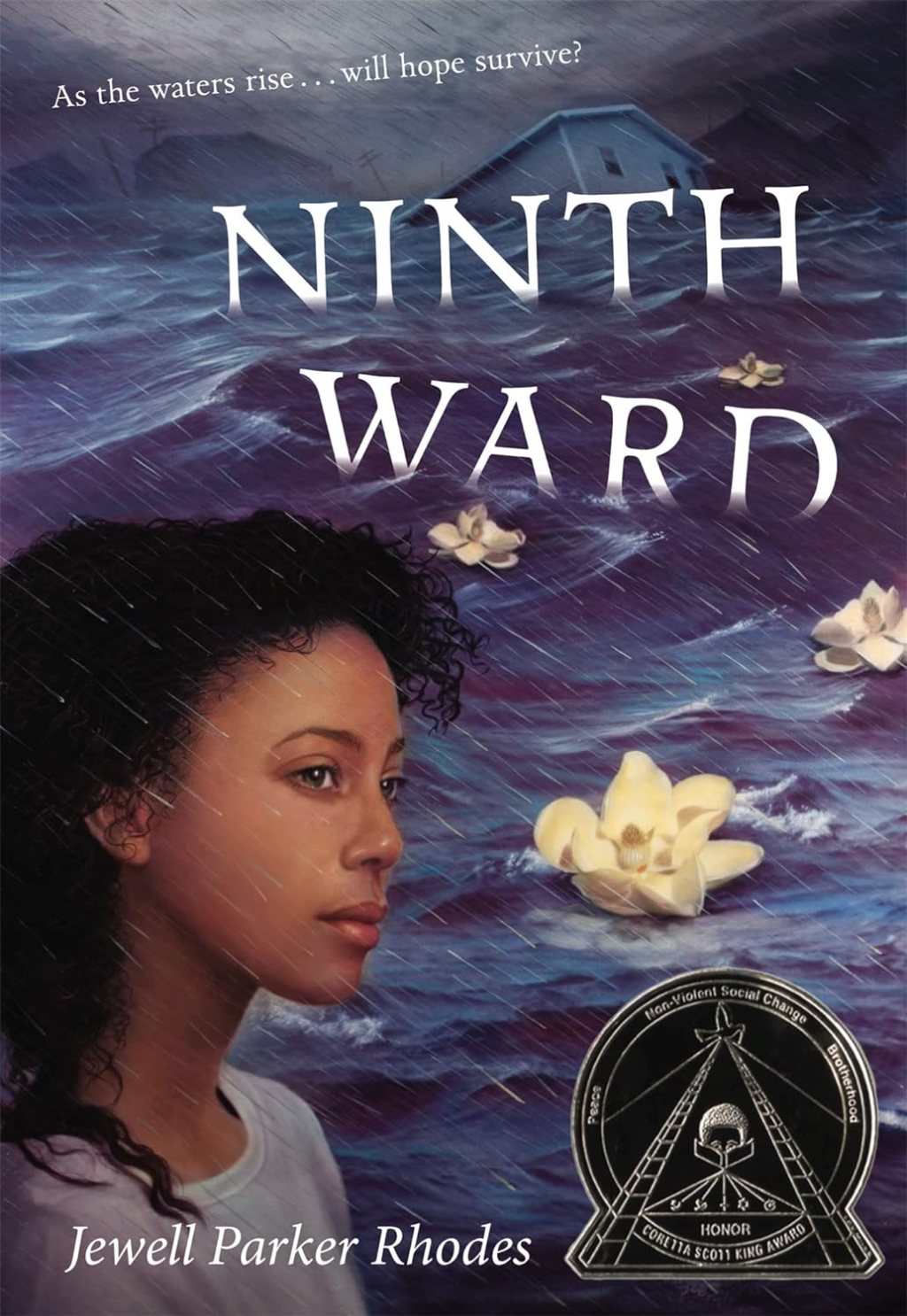
By Jewell Parker Rhodes, Little, Brown Books for Young Readers, 2012
On September 26, 2024, Hurricane Helene made landfall on Florida’s Gulf Coast as a Category 4. To everyone’s surprise, the storm ripped through the Southeast, leaving destruction in its wake. Asheville—a mountain city dubbed a “climate haven” due to its elevation and distance from the coast—and smaller towns in Western North Carolina (like Swannanoa and Chimney Rock) suffered devastating floods and mudslides. The damage caused by unprecedented rainfall and cresting rivers drew quick comparisons to August 2005. That’s when Hurricane Katrina, a category 5, slammed New Orleans, causing 1833 fatalities and costing more than $108 billion in damage. Considering Helene’s unexpected impact in Southern Appalachia, we’re revisiting one story of climate change, resilience, and Black youth: Jewel Parker Rhodes’ 2010 award-winning novel, Ninth Ward.
Ninth Ward is Rhodes’ first novel for young readers and the first book in her Louisiana Girls trilogy. Written after seeing children’s faces on the post-Katrina coverage, Rhodes wondered, “What about the children?” Three years later, after Hurricane Ike hit Texas and Louisiana, Rhodes’ protagonist, Lanesha, spoke to her. Ninth Ward was born.
The novel introduces readers to 12-year-old Lanesha, a girl born with a caul and the gift of sight, as the old folk say. Orphaned when her mother dies during childbirth—and her father’s siddity Uptown family refused to take her in—Lanesha’s left in New Orleans’ 9th Ward, in the care of Mama Ya-Ya, a former midwife who ushered her in the world. A (grand)mother figure, the 82-year-old seer loves Lanesha unconditionally. She pours into her, nourishing her spiritually, and reminding her, “Signs everywhere. Pay attention.” That she does. Lanesha, like Mama Ya-Ya, can see ghosts, and she often sees her dead mother’s spirit lingering in their house. Her gift wins her no friends. At school, other kids keep their distance, call her crazy or a witch–except TaShon, a quiet boy who becomes her friend.
The story turns tense when Mama Ya-Ya has visions of a hurricane headed their way. Sensing her own decline, Mama Ya-Ya pushes Lanesha to grow up and have faith in her own knowledge and gifts. Lanesha sometimes struggles to read the signs. But she senses the shifting atmosphere. She can smell and taste air. With no time to spare, Lanesha draws upon Mama Ya-Ya’s lessons and her own inner knowing to ride out the deadly storm.
What works?
Rhodes cradles Lanesha in a beautiful community of care. The intergenerational relationship between Lanesha and Mama Ya-Ya is tender and soaked in love. Lanesha’s math teacher recognizes Lanesha’s brilliance and encourages her to follow her dream of building bridges. The budding friendship between Lanesha and TaShon brings sweetness and some fun. And in the hours before Katrina hits, neighbors bust out grills to feed one another. Folks may not have much, but they come together in this close-knit community.
The story is suspenseful, emotional, and intense as the novel gives readers a glimpse into the chaos that Katrina brought to NOLA 19 years ago. Readers learn about mandatory evacuation orders, clogged highways as residents rushed to leave the city, the inability of many families (especially poor and working-class Black families in the 9th Ward) to just up and leave. Others make their way to the Superdome for shelter. The novel feels real.
What doesn’t work?
Ninth Ward presents a realistic and sensitive portrayal of the environmental and emotional impact of climate change. Through Lanesha, TaShon and Mama Ya-Ya’s experience, readers feel the confusion and chaos that come when a hurricane hits—especially when you’re caught in the hurricane’s eye. But the initial scenes about the floodwaters are confusing, as readers don’t know why the waters continue to rise. To her credit, Rhodes does include a letter to readers explaining that the levees broke. The ending feels a bit idealized, softening some of the emotional blows and loss that Katrina survivors—especially children—must feel.
Pass it or Grab it? Grab It. 9th Ward still stands as one of the few books about climate change written with Black children in mind. We see the preparation: boarding windows, preparing food in case of power outages, stocking up on water, staples, batteries, flashlights and all manner of emergency supplies. Recommended for public libraries and middle school collections, especially in Black communities seeking to prepare for a future of increased climate catastrophes.
 Black Cotton Reviewers