
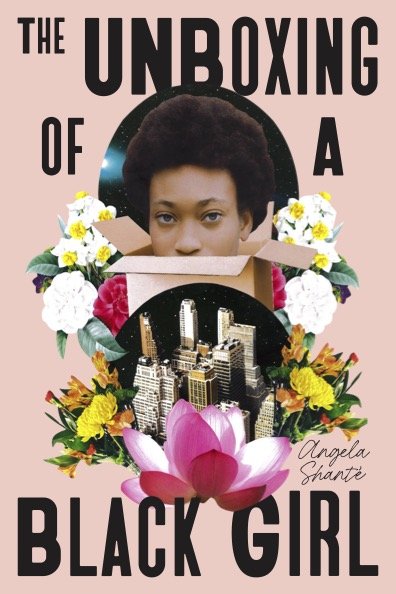
By Angela Shanté, Page Street YA, 2024
Angela Shanté is an award-winning author holding an MFA in Creative Writing and an MSED. She honed her skills both as a writer and an educator during her early career as a K-12 public school teacher in New York City.
As someone who was born in the 1980s and grew into my teens in the 1990s, I can relate to Angela Shanté’s The Unboxing of a Black Girl. The book contains a collection of poems and vignettes about the author’s coming of age and is set in New York City in the 1990s. It also examines the societal forces shaping the upbringing of Black girls. I appreciate that the author lists references for readers to conduct additional research. For example, in the poem titled Salt-N-Pepa, she provides a footnote that explains who the group Salt-N-Pepa is, which is helpful for girls reading this book who may not be aware of the Hip-Hop group. In that same poem, she references the Brown Paper bag test, stating, “my fair skin shades lighter than, her brown hues meant the world would get-out-that-sun, her and she’s so pretty, me a paper bag thin distinction.” The brown paper bag test refers to colorism within the Black community and gives context to a history explaining what a young girl reading these poems may face in her own life.
The book is divided into three sections: The Boxes We See, The Ones We Don’t, and The Ones We Shed. The poems are a journey through the life of a Black girl and offer an opportunity for Black girls to connect to an experience that may be similar to their own. It also gives Black girls the space to dream and unbox themselves from the boundaries that either society tries to put them in or that they have been taught to place themselves in. It can be read in one sitting or over time by selecting and reflecting on each poem when you are in the mood to read it.
What works: The poems use imagery that places the reader in the context of New York City in the 1990s. There is variety in the styles, with some poems and some vignettes. The references help readers learn about historical context, and Angela Shanté also provides discussion questions that parents can use with their children or teens as they read the book. The book is also suitable for educators who want to learn more about the world of a Black girl.
What doesn’t work: I can honestly say that nothing does not work in this book. Readers do need to have an open mind because it is written as poetry. If you are used to reading in a more narrative style, this will be an adjustment for you.
Grab it or Pass it: Grab it! Black girls and Black women alike will enjoy these poems. Not only Black readers but any reader will enjoy the book.
 Black Cotton Reviewers