
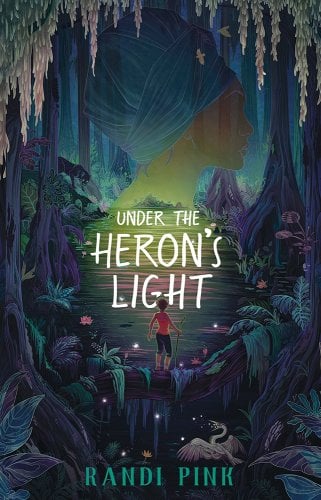
by Randi Pink. Feiwel and Friends, 2024.
Randi Pink is an author, educator and jazz vocalist who lives in Birmingham, Alabama. Her first YA novel, Into White, released in 2016. It was followed by Girls Like Us and Angel of Greenwood, both which became award winning titles. Pink describes Under the Heron’s Light as being inspired by the forces and his-stories that are buried in our natural environment. Her Dismal Swamp, a real place, becomes a personal in the book.
One night in 1722, Babylou Mac and her three siblings witnessed the murder of their mother by local preacher’s son. Babylou kills him in retaliation. Fear-filled, the four siblings seek refuge in the Great Dismal Swamp where they will be protected within the swamp’s natural—and supernatural—environment.
In present times, Atlas, a Black female college student, comes home to North Carolina for the annual Bornday cookout. But this Bornday, Grannylou’s storytelling isn’t quite the same. She disappears into Dismal and Atlas and her cousins are compelled to find the family’s well loved and much respected domineering matriarch. Their efforts require them to uncover all the mysteries that the swamp holds.
Every little house on Grannylou’s long street ran on the swap and switch, but her home was by far the most active. It was small, yes, barely a blip on the North Carolina map, but large in spirit.
Layered people with storied pasts and intricate connections to one another passing in and out of her creaking screen door. But also layered by history. Hard-fought battles and movements began and ended in this swamp. One fingernail scrape across the hydric soil could reveal the lifeblood of battalions of dead soldiers. But most of the history of our beloved swamp, like the rest of these United States, rested on the sacrifice of formerly enslaved people. (p. 11)
Centuries of family history, Black resistance and love, are rooted in the Dismal and are about to be dug up.
What works: Pink has filled this book with meaning and metaphor to enrich the natural environment of the Dismal. This is important as she developes the themes of environmental justice and love. By anthropomorphizing the Dismal, Pink is able to explore the exploitation of our natural environment.
The novel evolves from Grannylou’s repulsion of love to that very notion being what saves the day. To complete this reconsideration, from the normative, oppressive everyday concepts of love into the foundation for holistic justice, Pink carefully and compassionately creates a dynamic ecosystem for the family and land. The natural forces, the ‘magic’, enacted in this dynamic space make perfect sense, even when there’s hatred afoot.
What really works is pairing this with Tonya Bolden’s Crossing Ebenezer Creek.
What doesn’t work: Into the Heron’s Light is told from multiple points of view with time jumps. This may be confusing for some readers.
 Black Cotton Reviewers