
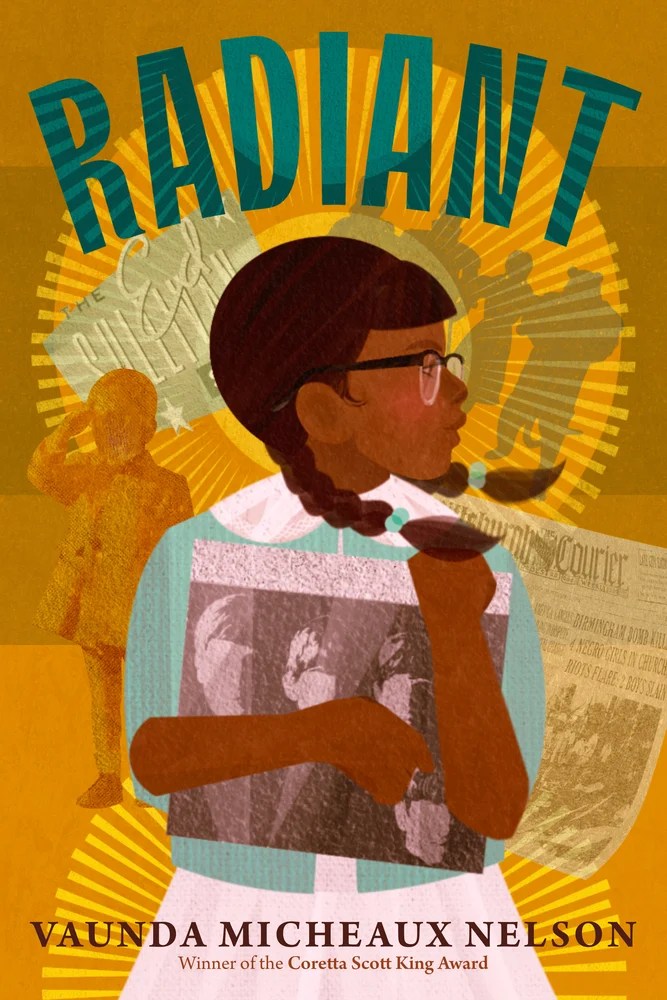
by: Vaunda Micheaux Nelson. Dutton/Penquin Random House, 2025.
Vaunda Micheaux Nelson grew up in a rural town in Pennsylvania where she and her brother were the first Blacks to attend the school. As a writer, she hopes to give young people some of the opportunities to grow through story that her parents gave her. Nelson has been a teacher, newspaper reporter, bookseller, recreation specialist, and children’s librarian. She has served on Newbery, Caldecott and Ezra Jack Keats awards committees. Vaunda is a graduate of Point Park University in Pittsburgh. She holds master’s degrees from the Bread Loaf School of English at Middlebury College, Vermont, and from the University of Pittsburgh School of Library and Information Science. Nelson writes because she has a love of story, and she uses that love to spread joy.
It’s 1963 and Cooper Dale just began the fifth grade where she faces both an extra-strict teacher and the bullying of Wade Carter, the only child of an upper middle class white family, whose home Cooper’s mother cleans for extra income. How can she shine when her mother works for the meanest boy in school? To make matters worse, Cooper quietly wishes she could be someone else and while she’s at it, couldn’t she be white?
It’s not all bad, though. Cooper’s middle-class family seems to provide quite well. She and her older sister, Maxine, have fallen for the Beatles, and Cooper is thrilled to have something special they can share. What she learns about her British idols adds new complexity to Cooper’s feelings about race. The book contains microaggressions, political assassinations which are briefly touched upon, and a death.It’s not all bad, though. Cooper and her beloved older sister have fallen for the Beatles, and Cooper is thrilled to have something special they can share. And what she learns about her British idols adds new complexity to Cooper’s feelings about race.
What Works: The historical novel written in first person takes us on young Cooper’s journey of beginning to understand the world in all its racialized complexities. Cooper’s a child of the sixties. She lives through political assassinations, bombings, the growth of Motown, and Beatlemania. Nelson’s writing reminds us how things around us shape and inform us.
In her majority white elementary school, Cooper is not provided any buffers. Oh, she has white friends, but they’re school friends. At home, she has affirming relationships with everyone in her family, especially her cousin, Kate. Cooper Dale has a lot going for her, she’s just a young Black girl trying to figure out the world; just a young Black girl being a young Black girl.
Snap, Crackle, Pop
I pour milk on my Rice Krispies
and sing “She Love You” to
the snap, crackle, pop
of my cereal.
Maxine sings along with me.
The Beatles are a miracle.
Fred butters some toast.
“Do I have to listen to this
first thing in the morning?”
Dad talks from behind his newspaper.
“I’d just like a little peace and quiet
while I try to find out if the world
is coming to an end.”
Mama pours milk
in her coffee.
“Settle down
and eat your breakfast.
We can’t dillydally.
I have an appointment this morning.”
Her no-nonsense voice quiets us,
but everyone
is smiling.
(p 136-7)
What Doesn’t work: Toward the middle of the book, Hakim joins the cast of characters. Nelson brings him in for a myriad of reasons, but he’s just too perfect. Should I criticize a Black boy for being too perfect when he delivers what the author intends?
Pass It or Grab It: I would definitely put this in middle grade and public libraries. In the complex ways that it deals with forgiveness and self-actualization the book could easily serve as a mentor text. It pairs well with Piecing Me Together (Renée Watson; Bloomsbury, 2017), Troublemaker (John Cho; Little, Brown 2022) and Partly Cloudy by Tanita S Davis (HarperCollins, 2021).
 Black Cotton Reviewers