
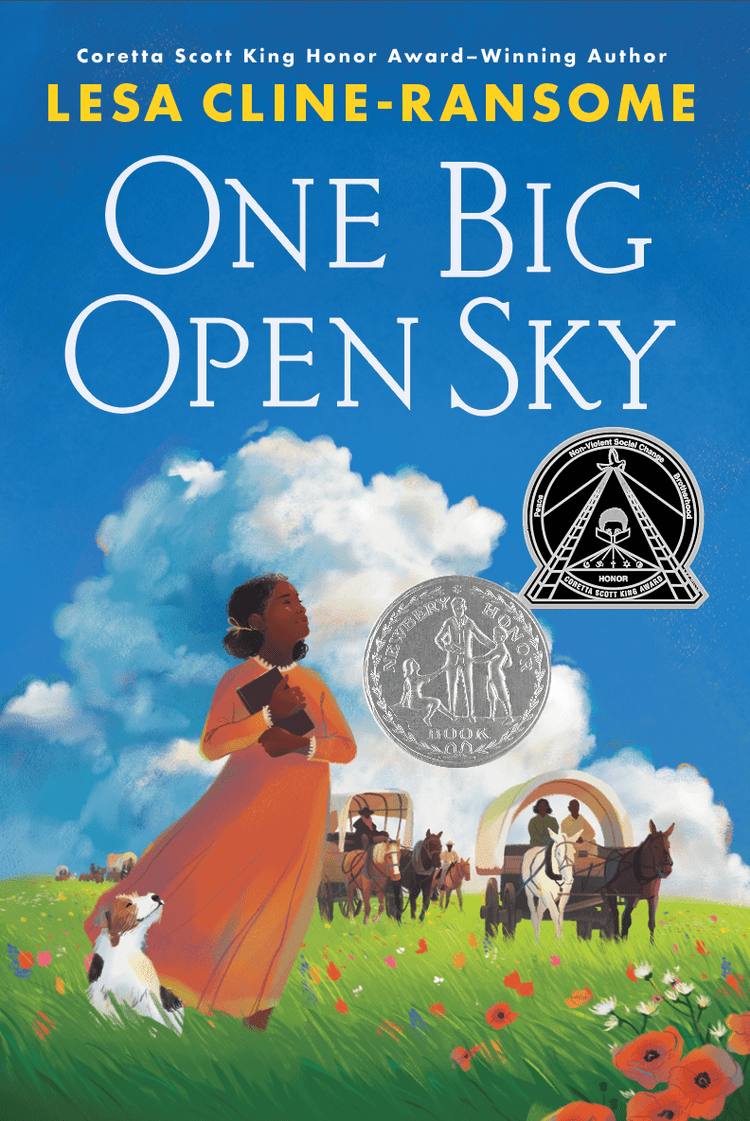
By Lesa Cline Ransome, Holiday House, 2024
Lesa Cline Ransome is an award-winning author of children, middle-grade and young adult books. One Big Open Sky, her middle-grade novel in verse, was a recipient of the Newbery Honor and Coretta Scott King Award Author Honor, as well as being named a Best Book of 2024 by Kirkus, the Boston Globe, and the New York Times.She grew up in Malden, MA, a suburb just outside of Boston. She has a BFA in Merchandising and Management from Pratt Institute and an MA in Education from NYU.
She lives in Rhinebeck, NY, with her husband and frequent collaborator, illustrator James Ransome, four children and a St. Bernard name Nola.
In an introductory video to her book, Lesa states, “growing up I read book after book about pioneers who traveled by covered wagons to the West. I always wondered about the lives they lived, the hardships and challenges they faced, while navigating the elements.” While wondering, she also had many questions about the pioneer life. She goes on to say “one of the biggest questions I had was were there any black Pioneers? I never quite knew that answer until I discovered an article years ago about the very first migration of Blacks leaving the south in 1879 following Reconstruction and heading west to claim free land offered under the Homestead Act of 1862. They called themselves the Exodusters.”
One Big Open Sky is the fictional story of three black female Exodusters, told by 11-year-old dreamer Letta, her heart sick mom, Sylvia and a young independent minded teacher named Philomena. In their own unique perspectives, these female characters tell their stories, their fears, the tragedies, dangers, and loss along the way. Letta is smart and very inquisitive, always asking questions, including those that adults don’t want to answer (“Why can’t we live here?”. . .in Independence, Missouri). Sylvia, the loving and dutiful wife, follows her husband, Thomas. She misses her family and friends she leaves behind. She is quiet but reveals her inner strength when necessary. Philomena needs to get to Nebraska for a teaching job. She joins the wagon train and clearly shows she can handle responsibilities.
What works: Ransome’s choice of characters are very appropriate for this story. These characters represent different ages and stages of life: a smart young girl, a mother and wife, and an independent single teacher. Each character narrates her story that matches her age and personality. The reader will appreciate reading each female’s story and her role during this migration. Although the men are not narrating their stories, their voices and personalities are revealed through their actions. They make the decisions and protect the families. For example, Thomas, Sylvia’s husband and Letta’s father, wants to be free and to own his own land. He decides that his family will travel to Nebraska. Thomas drives the wagon and protects his family during this difficult and dangerous travel. Speaking of difficult and dangerous travel, Ransome vividly describes the weather (“Lord, it rained so hard I was sure there couldn’t be no more rain left in the clouds”) and the landscape (rivers, steep riverbank, grass). This novel in verse is packed with action, emotion and more.
What doesn’t work: Everything works for that time period, from the clothing styles to the gender roles, the transportation, the racism and more. Some readers may need some historical context before reading this book.
Grab it or Pass it: Grab it. This book tells a story that some readers may know little or nothing about. Told from the female’s perspective, the readers learn a lot about these brave pioneers.
 Black Cotton Reviewers