
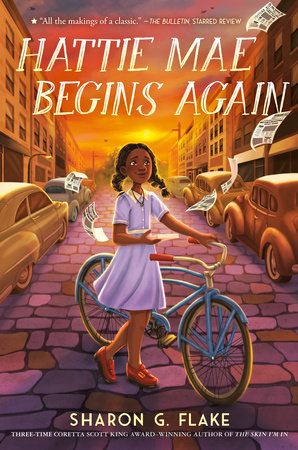
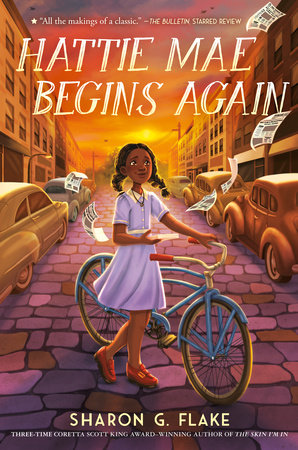
by Sharon G. Flake
Penguin Random House, January 2026
Sharon G. Flake is a three-time Coretta Scott King Honor author best known for the acclaimed The Skin I’m In. With deep family roots in Philadelphia, Flake draws on both personal history and extensive research to shape this story, grounding it in the lived experiences of Black families navigating change, movement, and opportunity.
This middle grade historical novel, written in verse, follows Hattie Mae as she leaves her family during the era of the Great Migration of the 1930s and 1940s, when many Black families moved north seeking new possibilities. Hattie is sent to an upper-class boarding school run by her cousin, where she struggles with not quite fitting in, learning how to handle bullies, forming friendships, and figuring out how to remain true to herself in unfamiliar spaces. Themes of belonging, resilience, friendship, and self-determination run throughout the story, alongside the pride of “making a way out of no way” and sustaining connections to both the communities left behind and the ones being built anew. Readers should be aware that the book touches on displacement, social isolation, and class tensions, all handled in an age appropriate way but relevant to current conversations about identity and access.
What Works
As a novel in verse, many scenes are brief, yet the sparse language carries tremendous emotional weight. Flake uses economy of words to say more, not less. Hattie’s singular perspective anchors the text as we slowly uncover who she is and what she stands for. While this is a companion to Once in a Blue Moon, it easily stands on its own. Philadelphia comes alive on the page, offering rich historical grounding that makes the book a strong companion to humanities units studying this period. The theme of self-determination is particularly powerful, showing young readers that they can take initiative, problem solve, and grow into themselves. The book also serves as a quiet reminder of how learning and schooling functioned before the digital age.
What Doesn’t Work
Some of the secondary characters feel underdeveloped and less engaging than they could be. In particular, the shift from bully to friend happens quickly and may not feel entirely plausible. While it helps move the narrative forward, the emotional transition could have used more depth.
Pass It OR Grab It?
Grab It. This is a strong addition for middle school collections, as well as public libraries serving tween readers. It works well for independent reading but also has clear curriculum connections for historical study, identity exploration, and discussions about migration and belonging. The concise verse format makes it accessible while still delivering depth. I found myself rooting for Hattie and would gladly follow her story further.
 Black Cotton Reviewers